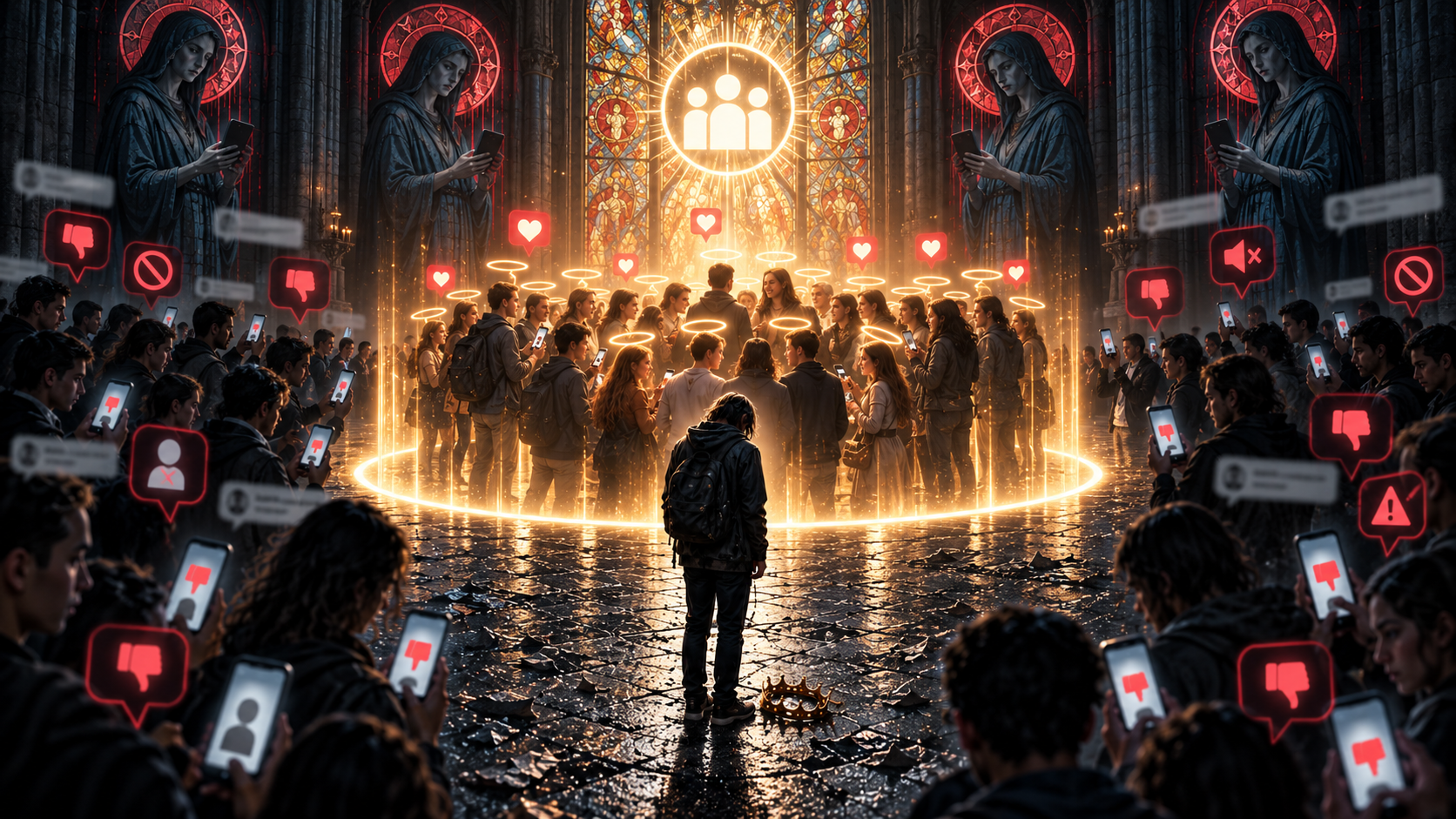
I've been thinking about the 90's a lot lately. Not the MxPx-on-the-discman version of it, walking down the street with light-up kicks and a tamagotchi clipped to your belt loop, half your pog and slammer collection rattling around loose in your backpack (sigh...). I mean the people. People felt kinder then, more patient with somebody being wrong out loud, more willing to let an argument in a classroom or lunch line just be an argument instead of a referendum on who you were as a person. I was a kid, so maybe I was blissfully naive, too young to have developed a radar for who the real assholes were. But I don't think that's the whole story.
When I was thirteen, I built a website. It had opinions, mostly about religion and philosophy, and people wrote back. One man was particularly offended by my blasphemous stances, and I remember explaining that I was only thirteen, I didn't know everything, and I was still learning. Then I went and learned some more.
I spent hours in message boards and chatrooms, engaging with people who had spent their entire adult lives studying subjects I'd only recently discovered existed. Some had doctorates. Some were probably every bit as uninformed as I was. But there I was, a kid from a lower-middle-class household, participating in discussions with people I would otherwise never have encountered. Nobody needed to know what my parents did for a living or which schools I attended. We engaged on the merits of the conversation itself, agreeing, disagreeing, challenging one another's arguments without needing to establish who was entitled to have an opinion in the first place. It was wonderful.
Of course, the early internet also had grown men pretending to be little girls and asking whether they could visit me. In the years that followed, Kazaa, LimeWire, Rotten.com, and eventually the Dnepropetrovsk maniacs exposed me to violence and human depravity that left images burned into my brain. And somehow I kept returning to the cesspool that was 4chan, where human depravity, memes, and basement-nerd activism against Scientology and the Westboro Baptist Church occupied the same ridiculous space. I'm under no illusion that the internet was ever some golden age of human decency.
But it opened my world up in a way that my circumstances hadn't allowed. For the first time, geography, money, and social standing weren't necessarily determining which ideas I could encounter or whose opinions I was permitted to challenge.
So what changed?
I don't think people suddenly became worse. The people running things were making the same self-serving decisions back then, and people were perfectly capable of being cruel long before social media. What changed was how much of the picture we could see, and eventually, how we were encouraged to respond to it.
Access to flight logs was limited. Depositions weren't sitting in easily searchable databases waiting for somebody to cross-reference them against decades of other records. Ordinary people had limited access to the machinery operating above them. The internet changed that, giving us unprecedented access to information and to one another.
And somehow, we've taken this extraordinary opportunity to understand the world and turned much of it into a competition to establish who's morally acceptable enough to participate.
Calling somebody "anti-vax" or "AI slop artist" or "conspiracy nut" can become a bid for safety - proof you're not the target, bought by crucifying somebody else. The person being pointed at is rarely a billionaire or powerful institution. It's someone at your own income bracket, in your own neighborhood, maybe even someone you used to be friends with before every disagreement became an indictment of character.
John Stuart Mill described something remarkably familiar in The Subjection of Women, published in 1869. He observed that when an opinion is rooted deeply in feeling, it can actually gain strength from the arguments made against it:
"It gains rather than loses in stability by having a preponderating weight of argument against it."
The reasoning collapses, but the conviction survives, demanding fresh arguments to defend it.
And decades earlier, in his 1838 essay Bentham, Mill explored how our circumstances shape what we're able to perceive, and what we inevitably miss. As he put it:
"None are more likely to have seen what he does not see, than those who do not see what he sees."
Nearly two centuries later, we're still struggling with this. Only now, admitting uncertainty can carry a social cost. Asking the wrong question invites suspicion. Changing your mind can feel like betraying your team. It's safer to learn the approved arguments, repeat them confidently, and dismiss anyone who challenges them.
What a terrible way to learn anything.
I'm still doing what I did at thirteen. Researching things, publishing opinions, discovering inconvenient evidence, occasionally abandoning an argument I was rather fond of. The ego is a bitch, but I'd rather find out I'm wrong than spend the rest of my life defending something simply because I happened to believe it first.
And the consequences of losing that willingness extend well beyond individual intellectual growth.
One less set of boots on the ground
Collective action doesn't run on agreement. It runs on people who disagree about plenty still being willing to stand in the same room and work on the same problem.
The moment showing up next to the wrong person becomes evidence against your own character, that willingness disappears. Nobody votes to end it. It just stops, because nobody wants to be next. Every friendship, every neighborly relationship, every loose coalition that ends over a character judgment like that is one less set of boots on the ground, armed with their own unique skills, experiences, and talents.
Meanwhile, we're facing problems that demand enormous collective effort. The genocide in Gaza and the American weapons and political support helping sustain Israel's military campaign. The expansion of government surveillance and the erosion of Fourth Amendment protections. Political corruption, economic inequality, and the concentration of power among people who rarely experience the consequences of their decisions.
Somebody might disagree with me about religion, vaccines, capitalism, or artificial intelligence and still share my concern about government surveillance. They might have information I don't, skills I lack, or an ability to reach people I never could. Why would I want to throw all of that away before we'd even begun?
There are genuinely dangerous ideas, and some disagreements have consequences too serious to overlook. But we've become so practiced at treating disagreement itself as evidence of moral failure that we're losing the ability to distinguish between the two.
And who benefits?
The billionaire Epstein-class, politicians who take their money, corporations whose decisions affect millions without meaningful accountability - they don't need to personally orchestrate every argument happening beneath them. People can independently respond to incentives that reward hostility and suspicion, and collectively destroy the relationships they would need to challenge concentrated power.
All that energy spent turning potential allies into enemies doesn't just vanish. It ends up serving exactly the people we'd need to unite against to fix anything at all.
So what do we do?
The instinct is to fight it publicly, declare ourselves independent of the political binary, build something that everybody can rally behind. But the moment you declare yourself outside it, you've created another identity for the system to absorb. The Tea Party became part of Republican politics, while Occupy's language and demands were appropriated by establishment Democrats. The binary doesn't care which direction you're facing when it comes for you.
I think the answer begins somewhere smaller, and it's better than it sounds. A real room instead of a feed. Showing up in person with your actual arms and legs instead of a username. A specific way of behaving instead of a declared identity. Letting a difficult question sit unresolved between two people without an audience waiting to decide who won.
I know the internet can still do extraordinary things. Thirteen-year-old me experienced that firsthand, and I wouldn't trade those encounters for anything. But I don't know that I've experienced much fruitful public debate online since AOL announced, "You've got mail."
We gained access to the entire world, and somehow started experiencing it through increasingly narrow windows.
Maybe there are still wonderful conversations happening everywhere, among people willing to disagree, learn, and change their minds. I hope there are. But I want to see more of those people doing something together, building relationships that can withstand disagreement, solving problems that exist beyond their screens.
The elites exploit our differences. How much more beautiful would it be if we built on our commonalities instead?
I still think about that angry man who emailed my thirteen-year-old self. He probably didn't change his mind about anything, but he helped change mine, even if that was the last thing he intended to do.
I'd like us to give one another that opportunity again.
No likes. No comments. No audience waiting to declare a winner. Just humans in shared space, bringing everything they know, everything they've experienced, and everything they haven't figured out yet.
Every person willing to show up beside somebody they don't completely agree with is one more set of boots already on the ground.
The path back to collective action starts there.